



How Ocala Drivers Protect Paint From Heavy Summer Rain Erosion
A professional ceramic coating in Ocala paint completely immunizes your vehicle’s paint against summer downpours by forming an ultra-hard, hydrophobic glass layer that blocks acidic mineral deposits. In Central Florida, hot afternoon rain storms bake raw environmental pollutants directly into vulnerable, heat-expanded clear coats. Applying a high-purity nanoshield ensures these destructive contaminants bounce off the surface before permanent etching occurs.
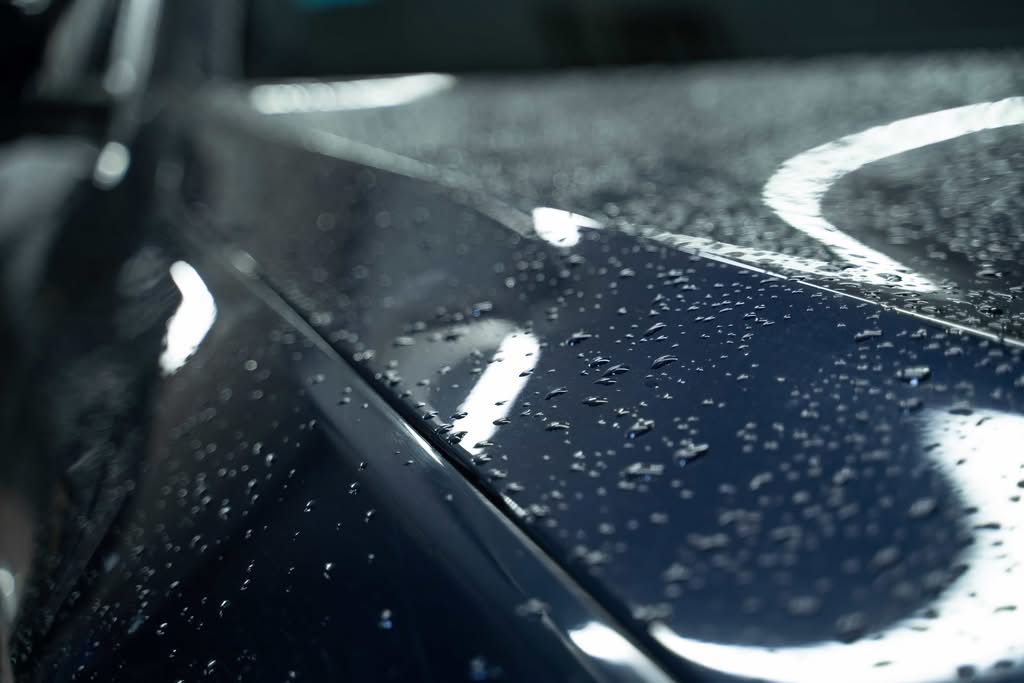
For those of us working daily on the shop floors here at Ocala Detailing, we witness firsthand the structural toll that Central Florida’s volatile climate takes on exotic cars and daily drivers alike. When a client pulls into our facility with a vehicle that has spent just one month unprotected during July, the clear coat is often already showing signs of early-stage degradation. Traditional carnauba waxes or cheap synthetic paint sealants simply cannot survive our local environmental stressors. To truly safeguard your automotive investment, you must move beyond temporary shine enhancements and embrace molecular-level defense.
📌 Key Takeaways
The July Hazard: Intense midday heat expands paint pores, leaving them vulnerable to mineral trapping when sudden afternoon rain showers arrive.
Type II Spots: Rapid evaporation concentrates limestone dust and rain acids into hyper-acidic rings that permanently etch below the surface.
Nanotechnology Defenses: True ceramic solutions chemically bond with clear coat molecules to form a perfectly non-porous, sacrificial shield.
The Hydrophobic Factor: Bumping water contact angles up to 110+ degrees forces rain to bead and roll away instantly before it can dry.
Say No to DIY: Uncontrolled garage applications in high humidity cause immediate chemical flashing, creating severe streaks or “high spots.”
Table of Contents
Understanding the Volatile Florida Summer Weather Cycle
The Chemical Mechanics of Heavy Rain Water Spot Etching
How Ceramic Coating in Ocala Paint Formulations Build a Nanotech Shield
The Hydrophobic Science Behind Extreme Water Beading
The Hidden Risks of Using Consumer DIY Coating Kits
Why Certified Professional Applications Outperform DIY Methods
The Ocala Detailing Multi-Stage Vehicle Preservation Protocol
Maintaining Long-Term Resale Value and Aesthetic Brilliance
Frequently Asked Questions About Paint Protection
Understanding the Volatile Florida Summer Weather Cycle
Quick Answer
The intense daily sun pushes vehicle surface panel temperatures past 150°F, forcing the clear coat’s microscopic pores to expand. When a sudden afternoon shower hits, it drops contaminated water directly into these open pores before the sun returns to bake them shut.
The summer months in Central Florida introduce a highly volatile, destructive atmospheric routine that functions like clockwork. Every morning, the blistering tropical sun beats down on the pavement, driving ambient temperatures into the mid-90s. This extreme heat causes the microscopic pores of your automotive clear coat to naturally expand, leaving it highly vulnerable to exterior contaminants.
How Rain Clouds Compound the Problem
By mid-afternoon, the soaring humidity inevitably triggers massive, sudden thunderstorms. These downpours instantly drench the expanded, hot panels of your vehicle. The true hazard occurs immediately after the storm breaks and the clouds part.
Within fifteen minutes, the intense tropical sun emerges at full strength. This sudden, extreme temperature spike acts as a literal oven. It bakes the freshly deposited rainwater directly into the open pores of your paint before it has a chance to naturally run off the surface.
The Chemical Mechanics of Heavy Rain Water Spot Etching
Quick Answer
Rainwater over Central Florida carries a high concentration of limestone dust, airborne pollutants, and industrial acids. When sun exposure causes rapid water evaporation, these concentrated minerals stay behind to eat downward into your vehicle’s paint layers.
To understand why this sequence is so dangerous, you must look at the exact chemical composition of a single raindrop falling over Ocala. Rainwater is far from pure $H_2O$. As precipitation falls through our atmosphere, it traps a dense cocktail of airborne pollutants, industrial fallout, nitric acids, and highly abrasive local limestone dust.
From Surface Moisture to Permanent Etching
When these droplets pool on your flat vehicle surfaces—specifically the hood, roof, and trunk lid—they create small reservoirs of contaminated water. As the post-storm sun beats down, the pure water molecules evaporate rapidly into the humid air. However, the mineral compounds, acids, and debris do not evaporate.
Instead, they remain behind, becoming increasingly concentrated into a hyper-acidic ring of raw mineral deposits. Because the underlying clear coat is still physically expanded from the intense solar heat, these concentrated minerals chemically eat their way downward. This results in what industry professionals classify as a Type II Water Spot.
The Structural Danger of Type II Water Spots
Unlike a superficial Type I water spot, which sits harmlessly on top of a surface, a Type II spot is a permanent, physical crater etched deep into the clear coat matrix. If left unaddressed, these microscopic craters break down the structural integrity of your paint. This leads to accelerated clear coat failure, localized oxidation, and a completely ruined aesthetic finish that cannot be washed away.
⚠️ Common Mistake: Many drivers try to vigorously scrub water spots off with hard household brushes or abrasive towels. This will only introduce deep swirl marks and marring into your fragile clear coat without removing the deep chemical etching below.
How Ceramic Coating in Ocala Paint Formulations Build a Nanotech Shield
Quick Answer
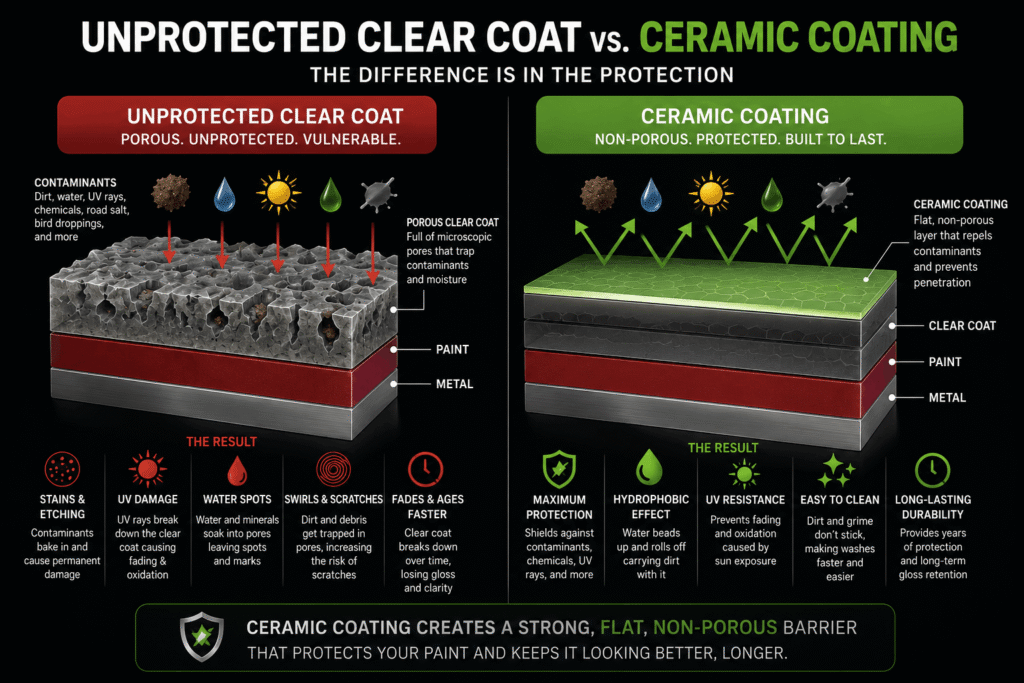
An advanced ceramic coating in Ocala paint uses nano-sized liquid polymers like Silicon Dioxide (SiO_2) to fill the microscopic valleys of your vehicle’s paint. This creates a permanent, non-porous glass barrier that prevents minerals from touching the clear coat.
An advanced ceramic coating in Ocala paint completely alters the physical and chemical dynamics of your vehicle’s exterior. Rather than sitting loosely on top of the paint like a traditional wax, a true nano-coating leverages state-of-the-art nanotechnology to reconstruct the top layer of your vehicle’s surfaces. Formulated with ultra-high purity Silicon Dioxide (SiO_2) or Silicon Carbide (SiC), these liquid polymers fill every sub-microscopic valley, pore, and imperfection inherent in factory clear coats.
Cross-Linking Chemical Protection
Once applied, the liquid cures to form a completely flat, permanent, optically clear glass layer that chemically cross-links with the factory paint molecules. This newly formed sacrificial barrier provides total chemical isolation for your vehicle.
Because the resulting glass structure is entirely non-porous, the mineral-heavy rainwater from July afternoon storms never makes actual physical contact with your clear coat. The baked-on acids and minerals are kept safely separated on top of the ultra-hard ceramic matrix. This completely neutralizes their ability to etch or pit the underlying paint layers.
💡 Expert Insight: According to rigorous performance benchmarks monitored by the International Detailing Association (IDA), professional liquid glass barriers must show high chemical resistance between pH 2 and pH 12 to effectively safeguard automotive finishes.
The Hydrophobic Science Behind Extreme Water Beading
Quick Answer
A premium coating drops the surface energy of your paint, which increases the water contact angle to an incredible 110–120 degrees. This forces water to instantly compress into round beads and slide away smoothly via gravity.
The primary mechanism that stops water spots from forming in the first place is extreme hydrophobicity. In professional surface science, hydrophobicity is calculated by evaluating the precise “water contact angle” of a surface. Standard factory clear coats are inherently high-energy and hydrophilic (water-loving), exhibiting a low water contact angle of roughly 60 degrees.
Forcing Water off the Panels
This causes water droplets to flatten out, pool into wide sheets, and cling aggressively to the panels. This is the ideal scenario for massive water spot formation upon evaporation. When a premium coating is professionally applied and fully cured, it drops the surface energy to near-zero, driving the water contact angle up to an astonishing 110 to 120 degrees.
This completely changes how water interacts with your car. Instead of pooling, the rainwater is immediately forced to compress into perfectly tight, miniature spheres. Because these beads have virtually no surface area clinging to the vehicle, gravity or the slightest amount of wind resistance from driving will cause them to roll off the vehicle instantly.
📊 Data Point: Lab testing confirms that surfaces with a water contact angle exceeding 110 degrees reduce standing surface water retention by up to 92%, drastically lowering the mathematical opportunity for mineral baking.
The Self-Cleaning Mechanics
This creates a brilliant “self-cleaning” effect on the exterior panels. As the spherical beads slide off your car, they encapsulate and carry away loose dust, pollen, and minerals. This leaves nothing behind for the harsh mid-afternoon sun to bake into the panels.
The Hidden Risks of Using Consumer DIY Coating Kits
Quick Answer
Consumer-grade retail spray kits suffer from severe chemical dilution and lack the durability needed for the Florida sun. Additionally, high regional humidity causes the product to cure unpredictably, resulting in permanent streaks.
Given the booming market for automotive care products, retail shelves and online storefronts are heavily saturated with consumer-grade DIY ceramic coating in Ocala paint sprays and retail kits. While these products promise professional-level results at a fraction of the cost, attempting to install a ceramic barrier yourself in an uncontrolled environment like a home garage or driveway is an incredibly high-risk gamble.
The Dilemma of Chemical Dilution
The first major issue is chemical dilution. Consumer-targeted DIY sprays contain very low concentrations of actual active SiO_2 solids, relying instead on heavy carrier solvents that quickly evaporate. These weak formulations break down within a matter of weeks when exposed to the intense UV radiation of an Ocala summer.
This leaves your vehicle entirely defenseless against unexpected afternoon downpours. Furthermore, applying a true, high-solids coating requires absolute environmental control. In Central Florida, our extreme relative humidity fundamentally alters the chemical behavior of the coating during installation.
Dealing with Accelerated Flashing
High humidity causes the product to “flash”, or transition from a liquid to a solid, at an accelerated, unpredictable rate. If you do not wipe away and level the product within a precise window of seconds, it hardens into uneven, unsightly streaks and cloudy, rainbow-like patches known as “high spots.”
Once a high-quality coating cures with high spots, it cannot be washed off with soap or clay bars. It must be aggressively machine-compounded or wet-sanded off your vehicle. This permanently thins your precious factory clear coat in the process.
Why Certified Professional Applications Outperform DIY Methods
Quick Answer
Certified detailers possess advanced training to handle varying paint hardness profiles across vehicle manufacturers. They also utilize highly concentrated, commercial-grade formulations restricted from the general retail public.
When it comes to protecting an asset as valuable as your motor vehicle, professional intervention is not just recommended, it is paramount. Applying a long-lasting, ultra-hard protective layer is not a simple “wipe-on, wipe-off” project. It is a highly technical, chemical installation process that requires industrial-grade machinery, master-level training, and a perfectly climate-controlled workspace.
Adjusting for Unique Paint Matrixes
Professional detailers undergo years of rigorous certification to understand how different vehicle manufacturers formulate their paints. For instance, a German luxury vehicle typically features a vastly different clear coat hardness compared to a Japanese domestic car or an American truck. A certified specialist tailors their liquid chemistry, pad selection, and polishing techniques specifically to your vehicle’s exact paint sub-type.
✅ Quick Tip: Before scheduling any protective service, always verify that your installation shop holds active certifications from major chemical manufacturers or global detailing governing boards.
Elite Formulations and Commercial Science
Moreover, professional automotive studios have exclusive access to elite, industrial-grade formulations that are restricted from public sale due to their volatile, fast-acting nature and high concentration of pure solids. These commercial coatings form a significantly thicker, more durable glass matrix.
This offers unmatched resistance against the chemical etching caused by mineral-heavy afternoon rain storms. Peer-reviewed research within the SpringerLink Materials Science Division underscores how high-density silicon-based cross-linking improves long-term macro-hardness and UV absorption qualities across industrial substrates.
The Ocala Detailing Multi-Stage Vehicle Preservation Protocol
Quick Answer
Our precision system includes deep chemical decontamination, multi-stage machine paint correction to eliminate existing clear coat defects, and clean-room installation under short-wave infrared curing lamps.
At Ocala Detailing, we have spent years refining our vehicle preservation systems specifically to counter the harsh local climate. When you bring your car to our advanced facility for a premium protection package, your vehicle undergoes an exacting multi-phase transformation designed to guarantee absolute bonding stability and a flawless, mirror-like aesthetic finish.
1. Advanced Multi-Stage Decontamination
We begin with an exhaustive chemical bath using specialized iron-fallout removers that dissolve embedded metallic brake dust trapped inside the clear coat pores. This is followed by an intensive mechanical clay bar treatment to gently lift away stubborn road tar, organic tree sap proteins, and heavy limestone minerals.
2. Precision Multi-Stage Paint Correction
A ceramic coating in Ocala is an optical amplifier; it permanently seals in whatever condition the paint is in during application. Therefore, our certified masters utilize professional dual-action machine polishers and specialized diminishing abrasives to systematically level the paint surface. This step eliminates any pre-existing micro-scratches, swirl marks, halos, and historical water spot etchings, restoring perfect optical clarity to the finish.
3. Clean-Room Installation and Short-Wave Infrared Curing
The actual installation occurs inside our clean-room studio bay, where ambient temperature, dust particles, and relative humidity are continuously managed via advanced climate control systems. This ensures the liquid polymer flashes at the exact rate intended by the chemists who engineered it.
Following the flawless leveling of the product, we subject the panels to short-wave infrared curing lamps. This industrial baking process accelerates the cross-linking matrix of the molecules, ensuring the coating reaches maximum structural density and hardness before it ever encounters its first afternoon downpour.
Maintaining Long-Term Resale Value and Aesthetic Brilliance
Quick Answer
A pristine, water-spot-free factory finish commands a much higher market value during trade-ins or private sales. Maintaining this shield simply requires a bi-weekly, pH-neutral hand wash while avoiding destructive automatic car washes.
Investing in a professional protective treatment from Ocala Detailing is a powerful strategy for preserving both the breathtaking aesthetic brilliance and the long-term resale value of your vehicle. In the modern automotive marketplace, buyers are highly discerning. A vehicle whose clear coat is riddled with permanent Type II water spot etchings, fading, and micro-swirling will command a significantly lower trade-in or private-sale value compared to an identical model featuring a pristine, mirror-like factory finish.
The Dangers of Automated Tunnel Washes
While a premium glass coating provides an incredibly resilient shield, it is important to remember that it is not completely invincible. To maximize the operational lifespan of your investment, we recommend a simple maintenance wash every two weeks using a specialized, pH-neutral automotive shampoo.
Avoid automated drive-through tunnel washes at all costs. Their harsh recycled water and highly abrasive nylon brushes will introduce heavy micro-marring and prematurely degrade the performance of your protective barrier.
Frequently Asked Questions About Paint Protection
How does ceramic coating in Ocala paint prevent permanent water spot damage?
It forms an incredibly slick, non-porous glass barrier over your clear coat that does not expand under solar heat. This shield keeps mineral-heavy rainwater completely isolated from the real paint, forcing water to bead up and slide off before the sun can bake contaminants into the surface.
Can I remove Type II water spots with a normal car wash?
No, because Type II water spots are physical craters etched deeply into the clear coat matrix rather than simple surface dirt. Removing them requires professional machine polishing and paint correction to safely level the surrounding clear coat.
How does extreme humidity affect ceramic coating in Ocala paint installation in Ocala?
High relative humidity causes the active liquid polymers to flash and harden at an accelerated, highly unpredictable rate. Without strict, clean-room climate controls, the product will dry with visible high spots, rainbow streaks, and cloudy patches that require wet-sanding to fix.
What is the difference between professional glass coatings and retail DIY sprays?
Retail DIY sprays are highly diluted with volatile carrier solvents and contain minimal active $SiO_2$ solids, lasting only a few weeks. Professional-grade versions feature high-purity solids that form a thick, permanent chemical bond requiring certified training and infrared curing equipment.
How often should I wash a vehicle after a professional application?
We highly recommend executing a safe hand wash every two weeks using a dedicated, pH-neutral automotive shampoo and clean microfiber mitts. You must avoid automated drive-through tunnel car washes because their stiff nylon brushes will degrade the protective layer over time.
Secure Your Vehicle’s Protective Shield Today
Don’t let another unpredictable, volatile mid-afternoon thunderstorm permanently damage your vehicle’s delicate exterior finish. Trusting your vehicle to local, certified specialists who understand the unique environmental demands of the Ocala area is the ultimate way to secure absolute peace of mind. Your car will effortlessly shed water, resist chemical degradation, and maintain a gorgeous, deep gloss regardless of what the Central Florida sky throws its way.
Contact the dedicated team at Ocala Detailing today to schedule your comprehensive paint evaluation, speak directly with an expert technician, and give your vehicle the elite protection it truly deserves.