



Which Paint Protection Survives a Brutal Central Florida Summer Heatwave?
When evaluating ceramic coating vs traditional wax for a Central Florida summer, nano-ceramic shields completely outperform carnauba options by chemically bonding to your paint and resisting heat up to 1,000°F. Traditional paste waxes soften and melt away at just 140°F, leaving your clear coat exposed to severe UV rays, lovebug acids, and hard water spots within weeks. Investing in a professional nanotechnology barrier provides permanent, high-gloss defense that will not wash off in afternoon downpours.
If you navigate your daily commute down Interstate 75 through Ocala, cruise along Silver Springs Boulevard, or park anywhere in Marion County, you already understand what a Central Florida summer demands from an automobile. July in our region isn’t just a calendar month; it is a relentless, multi-layered atmospheric assault on your vehicle’s delicate exterior finish. When local vehicle owners search for the absolute best way to defend their automotive investments from this harsh tropical climate, the ultimate detailing debate always centers on ceramic coating vs traditional wax.
📌 Key Takeaways
The Melting Reality: Traditional Carnauba wax liquefies and washes away completely when body panels cross 140°F in the midday sun.
Molecular Anchoring: True nano-ceramic coatings form a permanent, quartz-like glass shield that fuses with factory clear coats.
Acid Resistance: Nano-shields actively block highly destructive lovebug body fluids from etching permanent craters into front bumpers.
Self-Cleaning Advantage: High water contact angles ($110^\circ+$) force heavy rain to sheet off instantly, preventing Type II water spot baking.
DIY Hazards: Installing high-solid formulas in extreme local humidity triggers rapid chemical flashing, causing permanent, cloudy streaks.
Table of Contents
The Central Florida Summer Threat Matrix: Why Paint Fails
What is Traditional Wax? Understanding the Melting Point Problem
What is Ceramic Coating? The Nanotechnology Chemical Bond
Head-to-Head Comparison Across Crucial Performance Criteria
The Destructive Mechanics of Mid-Day Rain and Hard Water Spots
The Hidden Dangers of DIY Ceramic Coating Applications
Why Professional Application is the Only Smart Paint Solution
Frequently Asked Questions About Ceramic Coating vs Traditional Wax
The Central Florida Summer Threat Matrix: Why Paint Fails
Quick Answer
Punishing midday sun triggers photo-oxidation that degrades clear coat resins, while panel temperatures passing 150°F split brittle, low-tier sealants. Residual lovebug acids compound this damage by etching deep into the paint structure.
Before evaluating structural performance, we must dissect the unique regional elements that actively work to destroy your factory clear coat during mid-summer. Understanding this environmental threat profile helps explain why choosing between ceramic coating vs traditional wax is an essential financial asset preservation decision rather than a simple cosmetic luxury.
Intense UV Radiation and Photo-Oxidation
Central Florida receives a punishing dose of solar energy throughout July. Ultraviolet radiation actively breaks down the molecular bonds of automotive clear coats at an accelerated rate.
When your vehicle is left unprotected, these intense rays trigger a chemical degradation process known as photo-oxidation. This process pulls essential moisture out of the paint system, leaving your vehicle looking chalky, clouded, and deeply faded. Over time, this degradation leads to permanent clear coat failure.
Extreme Thermal Load
Dark-colored vehicles left in open parking lots around the Paddock Mall or local Ocala medical centers absorb incredible amounts of solar energy. On a 95°F July afternoon, exterior body panel temperatures routinely climb past 150°F, occasionally reaching up to 170°F on flat surfaces like hoods and roofs.
This extreme heat causes the underlying metal substrate and paint layers to expand and contract. This constant thermal movement introduces microscopic fractures in brittle, non-flexible surface sealants, rendering them useless within weeks.
Acidic Lovebug Swarms
While our heavy lovebug seasons typically peak in May and September, residual insect contamination remains a constant issue along rural Central Florida corridors throughout July. When these bugs collide with a speeding vehicle, their bodies rupture and instantly release highly acidic fluids.
When heated by the direct sun, these highly acidic compounds quickly activate. They etch deep into a standard vehicle clear coat within 24 to 48 hours, creating permanent, unsalvageable crater marks across your front bumper and hood.
What is Traditional Wax? Understanding the Melting Point Problem
Quick Answer
Traditional carnauba paste wax rests loosely on top of clear coats and features a low softening point of 140°F–160°F. When panels heat up in the direct sun, the wax liquefies and washes away completely during afternoon thunderstorms.
To properly contrast ceramic coating vs traditional wax, we must examine the physical properties of natural paste products. Traditional automotive wax has served as the baseline standard for detailing enthusiasts for nearly a century. Most premium paste waxes utilize natural Carnauba, a vegetable wax harvested from the leaves of the Brazilian Copernicia prunifera palm tree.
The Problem of Temporary Bonding
Detailers mix this hard, raw flake with natural oils and petroleum distillates to make a soft paste that can be wiped onto a vehicle’s panels. Once applied, it fills in the microscopic peaks and valleys of the clear coat, creating a warm, deep gloss and excellent initial water beading.
⚠️ Common Mistake: Relying on traditional carnauba wax to survive a Florida summer is a critical error. Because it does not form a chemical bond, it simply sits on top of the surface as a temporary oil film that breaks down rapidly.
The Tropical Softening Point
However, natural Carnauba paste possesses an inherent structural vulnerability that makes it ill-suited for our local summers: a low melting point. Pure, unrefined Carnauba softens at approximately 160°F to 180°F. When formulated into an easily workable automotive paste, its operational breakdown point drops even lower.
When your car’s hood reaches 150°F in the direct sun, the wax layer begins to soften and lose its structure. During our inevitable afternoon downpours, this softened barrier emulsifies and washes off the vehicle completely. At best, a high-grade paste wax provides only 2 to 4 weeks of true protection under our intense regional sun before evaporating.
What is Ceramic Coating? The Nanotechnology Chemical Bond
Quick Answer
Formulated with high-purity Silicon Dioxide (SiO_2), a ceramic coating fuses permanently with paint molecules to create an ultra-hard glass matrix. This shield features a melting point over 1,000°F, making it immune to heat.
Unlike traditional products that rest loosely on top of your paint, a modern ceramic coating utilizes advanced liquid nanotechnology to permanently transform your vehicle’s surface properties. These advanced formulations consist primarily of pure Silicon Dioxide (SiO_2) or Titanium Dioxide (TiO_2) suspended in a specialized liquid carrier solvent.
The Science of Silica Cross-Linking
When applied by a skilled specialist to a meticulously prepared paint surface, the liquid flows deep into the open pores of the factory clear coat. As the carrier solvent evaporates, the silica molecules undergo a cross-linking chemical reaction with your paint molecules.
This reaction cures into an incredibly hard, quartz-like glass shield that is anchored to your paint. Instead of serving as a temporary surface film, it becomes a semi-permanent extension of your factory clear coat.
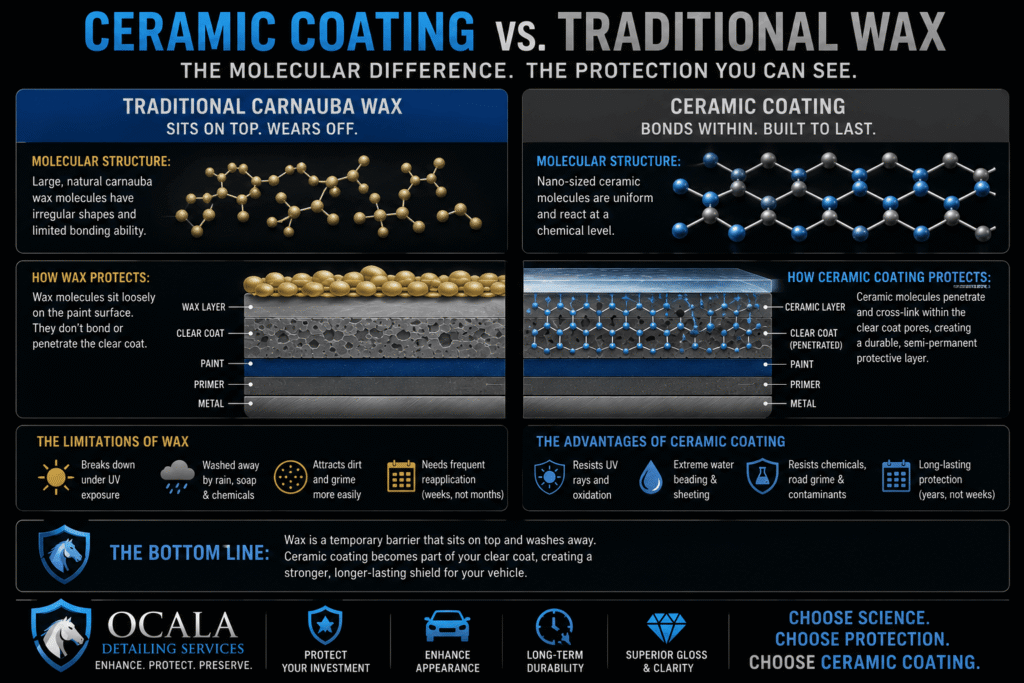
Total Immunity to Summer Temperatures
Because this new glass matrix is chemically bound to the car, it features an extraordinary melting point well above 1,000°F. This makes it completely immune to the highest summer temperatures Central Florida can throw at it.
Furthermore, true professional coatings score a 9H on the universal pencil hardness scale. This provides a rugged layer of defense that prevents fine wash marks, light micro-scratching, and environmental etching from damaging your factory finish.
Head-to-Head Comparison Across Crucial Performance Criteria
Quick Answer
When measuring ceramic coating vs traditional wax head-to-head, ceramic technology delivers vastly superior chemical resistance, UV deflection, extreme water sheeting, and multi-year longevity compared to short-lived carnauba pastes.
To help you visualize how these two protective options hold up under real-world conditions, let us compare their performance across the metrics that matter most to Florida drivers.
| Crucial Performance Criteria | Traditional Carnauba Paste Wax | Professional Nano-Ceramic Coating |
| Melting Point Profile | 140°F – 160°F (Liquefies in direct sun) | Exceeds 1,000°F (Immune to heat) |
| Florida Longevity Rating | 2 to 6 weeks maximum | 2 to 5+ years (With proper care) |
| Hydrophobic Action | Contact Angle: ~90° (Water Beading) | Contact Angle: $110^\circ+$ (Extreme Sheeting) |
| Chemical Resistance (pH) | Poor (Stripped by bug acids & detergents) | Immense (Resists pH 2 through pH 12) |
| UV Protection Level | Low (Degrades quickly under UV) | Excellent (Blocks oxidation completely) |
| Labor/Maintenance Cycle | Requires monthly reapplication | Requires bi-weekly simple wash |
UV Ray Deflection and Paint Oxidation
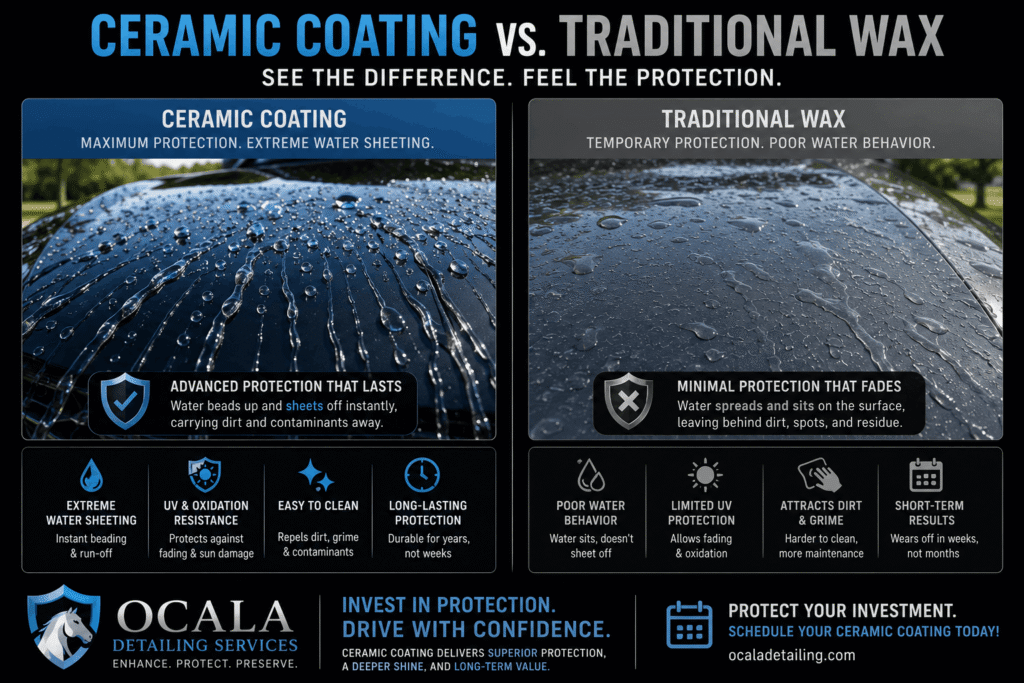
When evaluating ceramic coating vs traditional wax under our intense summer sun, the ceramic option is the clear winner. Waxes degrade rapidly when hit by UV rays. Once the wax layer dissipates, the UV rays hit your clear coat directly, causing the paint to look dull, chalky, and faded. A ceramic coating functions like a premium sunblock for your vehicle. It completely blocks UV rays from interacting with the paint pigments, ensuring your vehicle maintains its showroom shine for years.
Hydrophobic Action and Rain Management
Florida summer storms bring massive amounts of water. Waxes provide decent initial water beading, but they struggle to sheet water away quickly. Ceramic coatings create a hyper-smooth, low-surface-energy face. Water cannot grip it. Instead, rainwater beads up tightly and rolls right off the surface, carrying loose dirt and road grime away with it. This self-cleaning property drastically reduces the formation of stubborn hard water spots.
The Destructive Mechanics of Mid-Day Rain and Hard Water Spots
Quick Answer
Midday rain forms droplets that act as magnifying glasses, focusing solar heat directly onto your clear coat. As the water dries instantly, highly concentrated minerals bake downward into the paint layers, causing permanent Type II etching.
To understand why this comparison matters so much for local drivers, we need to examine the unique mechanics of water spot etching. The classic Central Florida afternoon storm pattern presents an immediate threat to your car’s paint finish.
Droplet Magnification Effects
When a brief rainstorm passes over a hot car, it leaves millions of tiny water droplets across the hood, roof, and trunk. If the storm clears quickly and the hot sun returns, those water droplets act like tiny magnifying glasses, focusing solar energy directly onto the clear coat.
As the water evaporates, any dissolved minerals, calcium deposits, and acid rain pollutants are left behind in a highly concentrated ring. On an unprotected or waxed surface, the high heat causes these minerals to bake directly into the clear coat, creating permanent water spots.
The Power of Hydrophobic Sheeting
A professional nano-ceramic coating prevents this damage through extreme hydrophobic sheeting. Because water cannot flat-pool on the surface, droplets bead up tightly and roll away before the sun can dry them in place. Any remaining mineral rings sit safely on top of the sacrificial glass shield, allowing them to be wiped away during a simple wash without damaging your factory finish.
💡 Expert Insight: According to automotive refinishing circulars preserved by the International Detailing Association (IDA), baked-on mineral deposits can breach a traditional wax barrier in less than twelve hours of continuous exposure to a high UV index.
The Hidden Dangers of DIY Ceramic Coating Applications
Quick Answer
High relative humidity causes retail ceramic coatings to flash at an accelerated, unpredictable rate, leading to cloudy “high spots.” Correcting these permanent smudges requires aggressive machine-compounding or wet-sanding.
With the massive surge in popularity of ceramic technology, retail shelves are packed with “DIY ceramic spray waxes” and consumer-grade coating kits. It can be incredibly tempting to buy an inexpensive bottle online and spend a Saturday afternoon attempting to coat your car in your driveway or garage. However, we strongly discourage taking the DIY route when it comes to true ceramic coatings.
1. High Spots and Permanent Flaws
If a ceramic coating is applied unevenly or left to flash (dry) for even a few seconds too long, it creates what detailers call “high spots.” These look like dark, oily, iridescent smudges beneath the surface. Because the coating bonds chemically to your paint, high spots cannot be washed or buffed out by hand. The only way to remove them is to machine-compound or wet-sanded off your vehicle’s paint, risking your clear coat in the process.
2. Trapping Imperfections Below the Glass Layer
A ceramic coating is completely transparent, acting like a magnifying glass for your vehicle’s paint. If your paint has microscopic scratches, swirl marks, oxidation, or embedded iron contaminants, a ceramic coating will seal them underneath a hardened glass layer. If you do not perform flawless paint correction first, you will permanently trap those visual flaws for the next few years.
3. Lack of Environmental Control
To cure properly, ceramic coatings require stable temperatures and low humidity during the first 24 hours of application. Trying to apply a professional nano-coating in an open Florida garage during July, with 90% humidity and blowing dust, is a recipe for complete product failure. The coating will flash too quickly, trapping moisture and dust particles inside the matrix.
Why Professional Application is the Only Smart Paint Solution
Quick Answer
Certified installations utilize multi-phase chemical decontamination, deep dual-action clay treatments, and precise machine paint correction inside a fully managed, climate-controlled clean room studio.
Achieving deep gloss and multi-year durability requires professional installation. At Ocala Detailing, our certified technicians follow a rigorous multi-stage preparation and application protocol inside a clean, climate-controlled studio. True paint protection is 90% preparation and only 10% application.
The Professional Preparation Protocol
When you bring your vehicle to our studio, it undergoes a meticulous preparation cycle designed to ensure a perfect chemical bond:
Decontamination Wash: We use specialized foam cannons and iron-dissolving chemicals to strip away old waxes, road tars, and embedded industrial fallout.
Clay Bar Treatment: The entire painted surface is gently treated with an automotive clay bar to lift out microscopic contaminants from the pores of the clear coat.
Multi-Stage Machine Paint Correction: Using professional dual-action polishers and specialized compounds, we level out micro-scratches and swirl marks. This restores absolute clarity and depth to the paint, creating a flawless canvas.
Isopropanol (IPA) Wipe Down: We strip away all polishing oils to ensure the bare clear coat is exposed for maximum chemical bonding.
Controlled Environment Curing: The coating is carefully applied section-by-section in a clean, climate-controlled facility away from the unpredictable Florida weather.
✅ Quick Tip: As of 2026, premium ceramic formulations feature specialized cross-linking polymers that drastically reduce daily dust cling, meaning a simple bi-weekly water spray is all that is required to maintain a perfect shine.
Frequently Asked Questions About Ceramic Coating vs Traditional Wax
Why does traditional carnauba wax fail so quickly during a Florida July?
Traditional carnauba wax possesses a low structural softening threshold between 140°F and 160°F. Because dark vehicle panel temperatures in Ocala routinely surpass 150°F in direct sunlight, the wax layer liquefies and washes away completely during midday rainstorms.
Can a ceramic coating prevent lovebug acid damage on my front bumper?
Yes, a professional nano-ceramic coating offers exceptional chemical resistance across a pH 2 to pH 12 range. This sacrificial glass shield completely blocks highly acidic lovebug body fluids from making direct contact with your delicate factory clear coat.
How often do I need to reapply a ceramic coating vs traditional wax?
Traditional carnauba paste waxes require labor-intensive manual reapplication every 2 to 6 weeks under intense sun exposure. In contrast, a professionally applied nano-ceramic coating forms a permanent chemical bond that shields your vehicle for 2 to 5+ years.
What happens if a ceramic coating is applied over paint scratches or swirl marks?
Because ceramic coatings are completely transparent and act like an optical amplifier, applying them over paint defects will permanently trap those scratches, halos, and swirl marks beneath the hardened glass layer for several years.
Is it safe to wash a ceramic-coated car in an automatic tunnel car wash?
No, you must avoid automated drive-through tunnel washes because their abrasive nylon brushes and recycled water will introduce heavy micro-marring. Maintaining your protective glass shield simply requires a gentle hand wash with a pH-neutral shampoo.
Protect Your Investment with Ocala Detailing
When comparing ceramic coating vs traditional wax for a Central Florida July, traditional wax simply lacks the durability to withstand our extreme environment. It melts away within weeks, leaving your vehicle completely exposed to severe UV damage, lovebug etching, and hard water spots. A professionally installed ceramic coating offers the ultimate shield for your vehicle. It delivers an unyielding, high-gloss barrier that handles the heat, repels water, resists environmental acids, and makes washing your car incredibly easy.
Do not risk ruining your vehicle’s paint with an unpredictable DIY kit. Trust the trained, certified experts who understand the unique demands of the local climate.
Ready to protect your vehicle with a premium, long-lasting glass shield? Learn more about our specialized Ocala Detailing Services and explore our premium Ceramic Coating Packages to schedule an appointment with our elite detailing team today.