



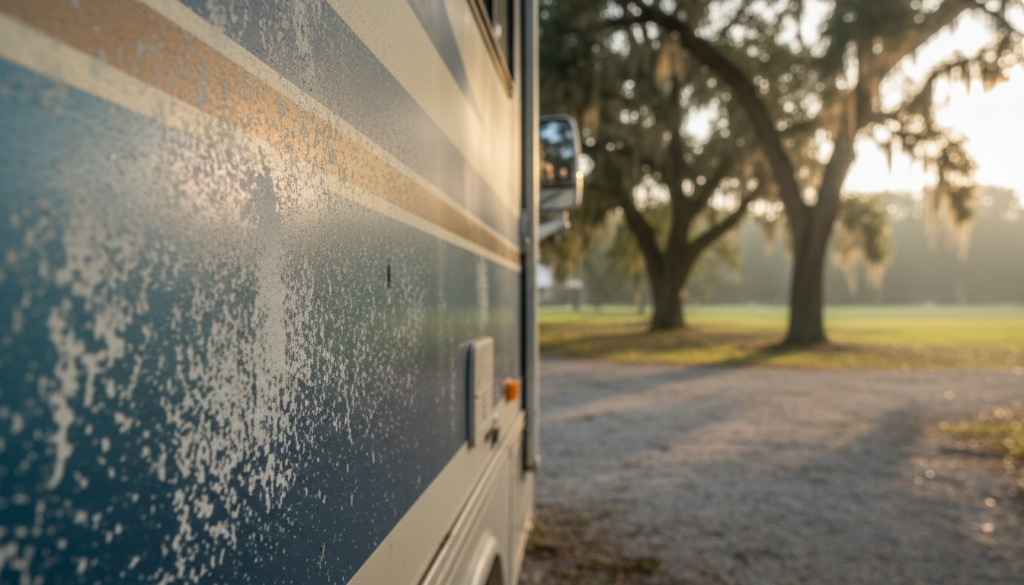
If you’ve typed "rv oxidation removal near me" into Google while staring at a chalky, dull motorhome in your driveway, you’re not alone. Florida sun is brutal on gelcoat and paint, and that white, powdery film isn’t dirt — it’s oxidation, and it only gets worse with time. The good news: a proper correction process can bring back the shine, and it doesn’t require replacing panels or paying for a full paint job.
Oxidation happens when UV rays break down the resin binders in your RV’s clear coat or gelcoat, leaving pigment exposed and unprotected. Left alone, it turns to chalking, then cracking, then permanent dullness that no amount of soap and water will fix. Catching it early with a mobile detailing crew that understands Florida’s climate is the difference between a one-time correction and an expensive repaint.
📌 Key Takeaways
- Oxidation is UV-caused resin breakdown, not surface dirt — washing alone won’t remove it.
- Marion County’s intense sun and humidity accelerate oxidation faster than in northern states.
- Machine polishing with graduated compounds is the standard fix for chalky, faded RV paint.
- A ceramic coating after correction slows future oxidation and extends the results.
- Mobile RV detailing in Ocala saves you the hassle of towing a rig to a shop.
Table of Contents
- What RV Oxidation Actually Looks Like
- Why Ocala’s Climate Speeds Up Fading
- DIY vs. Professional Oxidation Removal
- The Step-by-Step Correction Process
- Protecting Your RV After Restoration
- Frequently Asked Questions
What RV Oxidation Actually Looks Like
Quick Answer: Oxidation appears as a chalky, dull, or hazy film that rubs off white on your hand or a towel. It signals UV breakdown of the clear coat or gelcoat, not ordinary road grime.
Most RV owners first notice oxidation on the roof cap, front cap, and horizontal surfaces that catch the most sun. Fiberglass sidewalls fade unevenly, sometimes leaving streaky patches near decals or trim where UV exposure differs.
Early Signs vs. Advanced Oxidation
Early-stage oxidation looks like a slight loss of gloss — the paint reflects less light but still feels smooth. Advanced oxidation feels rough, chalky, and leaves a white residue on your fingertips after a light rub.
According to the Environmental Protection Agency, UV radiation intensity varies by season and region, and Florida consistently ranks among the highest exposure zones in the continental U.S. That constant bombardment is exactly why RVs stored outside in Marion County fade faster than those in shadier climates.
⚠️ Common Mistake: Scrubbing oxidized paint with a stiff brush or heavy detergent often makes it worse, grinding oxidized particles deeper into the clear coat instead of lifting them off.
Why Ocala’s Climate Speeds Up Fading
Quick Answer: High UV index, humidity, and long storage periods outdoors all combine to accelerate gelcoat breakdown faster in Central Florida than in milder climates.
RV owners in Ocala, Belleview, and Summerfield often store rigs outdoors between trips to The Villages or beyond. Without covered parking, the roof and front cap absorb hours of direct sun almost year-round.
The Role of Heat and Humidity
Heat accelerates the chemical reactions that break down resin binders, while humidity contributes to microscopic surface pitting. The National Weather Service tracks UV index levels that regularly hit "very high" to "extreme" across Marion County in summer months, which is exactly when we see the most oxidation service calls.
I’ve pulled up to driveways in Dunnellon and Silver Springs where a five-year-old fifth wheel looked more like fifteen years old, simply from sitting uncovered through several Florida summers. It’s not neglect — it’s just what our sun does to unprotected gelcoat.
💡 Expert Insight: RVs stored under a carport or reflective cover in Fort McCoy or Reddick can extend the time between oxidation treatments significantly, even without changing your wash routine.
DIY vs. Professional Oxidation Removal
Quick Answer: Light oxidation on a small area might respond to consumer polish, but moderate-to-heavy oxidation typically requires machine compounding that most owners aren’t equipped to do safely.
DIY oxidation removers can work on small, lightly faded spots if you’re patient and careful. But uneven pressure or the wrong compound grit can burn through thin clear coat, especially on decals or curved fiberglass corners.
When to Call a Professional
If chalking covers large panels, the roof cap, or has been building for more than a year, professional-grade rotary or dual-action polishing is usually the only reliable fix. This is the point where most Marion County owners search for RV oxidation removal near me instead of buying another bottle of store-bought polish.
| Factor | DIY Approach | Professional Correction |
|---|---|---|
| Equipment | Handheld polish, towels | Variable-speed polishers, graduated compounds |
| Time investment | 1-2 full weekends | Typically 1 day, mobile on-site |
| Risk of damage | Higher (uneven pressure) | Low (trained technicians) |
| Result longevity | Weeks to a couple months | Months, longer with ceramic coating |
| Best for | Small, light chalking | Moderate to heavy oxidation, full rigs |
📊 Data Point: Fiberglass RV panels have a thinner gelcoat layer than automotive paint, which is one reason RV Industry Association-recognized best practices recommend gentler, graduated compounding rather than aggressive automotive-grade cutting pads. See more from the RV Industry Association.
The Step-by-Step Correction Process
Quick Answer: A proper oxidation removal job moves from wash and decontamination, through graduated compounding, to polishing and sealing — skipping steps shortens the results.
We don’t jump straight to compound. Every job starts with a full wash and clay bar decontamination to strip bonded contaminants that would otherwise scratch the surface during polishing.
Step 1: Wash and Decontaminate
A pH-balanced wash removes loose dirt, then a clay bar or chemical decontamination lifts embedded grime, tree sap, and mineral deposits that plain soap can’t touch.
Step 2: Test and Compound
We test a hidden panel section to gauge how much clear coat or gelcoat remains before choosing a compound strength. Heavier oxidation needs a more aggressive cutting compound; lighter fading needs only a finishing polish.
Step 3: Polish and Refine
A finishing polish removes any haze left by compounding and restores true gloss and depth to the color. This step is what separates a "good enough" wash from an actual correction.
Step 4: Seal or Coat
Once the surface is corrected, we apply a sealant or ceramic coating to lock in the results and slow future UV damage. Skipping this step means oxidation starts creeping back within weeks instead of months.
✅ Quick Tip: Ask any RV oxidation removal near me provider whether their process includes a protective sealant or coating step — correction without protection fades fast in Florida sun.
For rigs with fifth wheel or travel trailer construction, panel shape and trim details change how compounding is applied; our fifth wheel detailing and motorhome detailing services are built around those differences. If oxidation is paired with heavy dirt buildup, our RV washing and detailing services usually get bundled into the same visit.
Protecting Your RV After Restoration
Quick Answer: A ceramic coating or sealant applied after correction is the most reliable way to slow the return of oxidation, especially for rigs parked outdoors in Ocala, Wildwood, or Summerfield.
Once oxidation is removed, the surface is at its most vulnerable point — bare, freshly polished gelcoat still absorbs UV the same way it did before. Applying protection immediately is non-negotiable if you want the results to last.
Ceramic Coating vs. Traditional Wax
Traditional wax offers a few weeks of protection and needs frequent reapplication. A ceramic coating chemically bonds to the surface and can last considerably longer, though it still requires proper maintenance washing to perform as expected — details we cover in our ceramic coating vs. traditional wax comparison.
Building a Maintenance Routine
Regular washing between full corrections keeps contaminants from building up and buys more time before the next oxidation treatment is needed. Our mobile RV wash and wax near me service is designed as that in-between maintenance step for owners across Marion and Sumter counties.
💡 Expert Insight: Owners in Gainesville and Newberry who schedule seasonal wash-and-wax visits between full corrections typically see far less chalking come back the following summer.
Heavy oxidation is not unique to motorhomes — we see the same UV damage on equine trailers hauled to shows around Micanopy and McIntosh, and on toy haulers stored between weekend trips. The underlying fix is the same: correct, then protect.
Frequently Asked Questions
How much does RV oxidation removal cost near Ocala?
Pricing depends on rig size, oxidation severity, and whether a ceramic coating is added, since heavier chalking requires more compounding time. Most owners get an accurate number after a quick on-site or photo-based estimate rather than a flat quote over the phone.
Can oxidation be removed without damaging RV decals?
Yes, when a technician tapes off or works carefully around decal edges and adjusts compound pressure near graphics. Aggressive machine polishing without that care can lift edges or dull printed decals, so experience matters here.
How often does an RV need oxidation removal in Florida?
Rigs stored outdoors in Marion County often need a full correction every one to two years, depending on sun exposure and prior protection. A rig with an existing ceramic coating usually goes longer between treatments than one with only wax.
Is rv oxidation removal near me the same as a full paint correction?
It’s closely related — oxidation removal is essentially a paint or gelcoat correction focused on restoring gloss lost to UV damage. The compounding and polishing steps are nearly identical to automotive paint correction, just adapted for fiberglass panels.
Does mobile RV detailing work for oxidation removal?
Yes, a mobile setup with proper polishers and power access can complete most oxidation jobs on-site in your driveway or storage lot. This saves owners in Belleview, Ocklawaha, and The Villages the hassle of towing a large rig to a shop.
Will oxidation come back after it’s removed?
Some UV fading will eventually return since Florida sun never stops working on exposed surfaces. Sealing the corrected paint with wax or ceramic coating, plus regular washing, significantly slows how fast it reappears.
Can I prevent oxidation instead of fixing it later?
Covered storage, regular washing, and an applied sealant or coating are the best prevention tools available. Catching light fading early with a quick polish is far cheaper than waiting for heavy, rough chalking to set in.
Final Thoughts
Chalky, faded RV paint isn’t permanent, and it doesn’t mean your rig needs an expensive repaint. With the right graduated compounding, polishing, and protective sealant, most oxidation damage across Marion, Sumter, and Alachua counties can be corrected and kept at bay for a long time. As of 2026, Florida’s UV exposure remains among the highest in the country, so protection after correction isn’t optional — it’s the whole point.
- Inspect your RV’s roof, front cap, and sidewalls for chalking or dull patches.
- Request a free on-site or photo estimate to gauge oxidation severity.
- Schedule a correction and protective coating before your next long trip.
- Set a maintenance wash schedule to extend the results season after season.
Ocala Detailing is a licensed, insured mobile detailing service serving Ocala and surrounding Marion, Sumter, and Alachua county communities. If you’re ready to stop searching for rv oxidation removal near me and just get it fixed, book your free on-site estimate today and let’s bring that shine back.